Sabtu, 10 April 2004

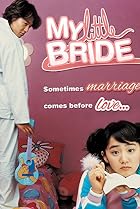
My Little Bride

Image of My Little Bride

My Little Bride is such a sweet, little film that gets the credit for my present addiction towards Kdramas. It was a huge hit and is one of the most watched movies by the Non-Korean audience. I love it and it fills me with exuberance every time I watch it!!
Kim Rae Won is a wannabe playboy, fresh out from college and Moon Geun Young is still in high school. Both of them are best friends since childhood. They are forced to get married due to family pressure and then starts their journey towards dealing with this new relation between them and realizing the love they always had but were oblivious towards it. Also, our heroine hides this thing from her school mates, which make the things more interesting for us. And yeah, she even has a crush on one of the boys there.
The movie is cute beyond words and the age gap between the leads never looks weird and of course it’s not very large. Together, Kim Rae Won and Moon Geun Young set off such sparks, that the strength of their chemistry alone is enough to make you love this film. The movie is full of many romantic and cute moments. All the characters make you feel warm. I cannot say much about the music, but I liked the song that is played in the end credits. Marriage of convenience is one of my darling topics and this film shows it beautifully. The day to day life of the persons, who never treated each other romantically but now live under the same roof, is filmed with much detailing and good pace. The movie binds you with its simple charm, its immensely likeable characters, and the intrinsic humor in the writing. The direction is really good.
My Little Bride has a lot of heart and the emotional part is attached with the script naturally and effectively. You feel with the characters.
Kim Rae Won is amazing in this role, perfectly balancing the immature, childlike behavior and the mature husband part. He is the kind of actor, the more you see him, the more you like him. He has a lot of warmth attached to his acting. Moon Geun Young is brilliant in this role, showing the cuteness and dilemma of getting married so early. They both share an adorable camaraderie. Rest of the supporting cast perfectly compliments the leads.
It’s a movie that wins you with its sweet, heartwarmng moments that will surely bring a smile to your face. I felt disappointed when the film ended as I wanted it to go on forever….

Jumat, 16 Januari 2004

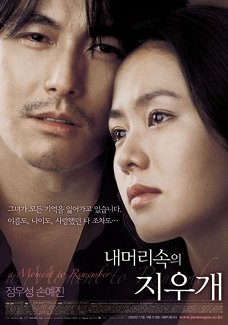
A Moment to Remember

Image result for A Moment to Remember


*Attention! Spoilers*
Kim Su-jin (Son Ye-jin), a gorgeous, young woman is stood up by her lover (Baek Jong-hak), who was supposed to pick her up at the station. Heartbroken and tired, she walks into a random convenience store, buys a coke and decides to walk home. A couple seconds after she leaves the store, she realizes that she forgot her coke inside the store. At the door she meets a handsome, rugged young man (Jung Woo-sung) holding a coke in his hand. She just assumes it’s hers. He opens the can. She takes the soda from him, chugs it down her throat and burps in his face: It’s the beginning of a beautiful love story.

A Moment to Remember (original title: 내 머리 속의 지우개, romanized: Nae Meorisogui Jiugae, which literally means: “Eraser in my head”) is a sappy South Korean melodrama, about a 27-year-old woman diagnosed with Alzheimer’s. It’s an incredibly sad and tender story, that made me tear up quite a bit, to the point where I even had to pause it, because I couldn’t read the subtitles anymore. I rarely go for this type of films, but for some strange reason I was in the mood to watch this yesterday, knowing full and well that I would probably cry like a baby. The whole film is designed to make you weep, and guess what: It works.
The first act of the film is all about setting up the perfect romantic scenery: Girl meets boy, they fall in love, everything is perfect. In the second act you start to see how Su-jin’s condition starts to progressively get worse. The first stages of Alzheimer’s are played for laughs and make the character of Su-jin seem even cuter and more adorable than she already is, but then, as the disease gets worse it’s just one sad scene after the other. Why is it so sad though? Does the film work as a melodrama? What make this such an emotional roller coaster? What does the film have to say about memory loss? And why all the glaring product placement?
Son Ye-jin gives a solid performance as Kim Su-jin, the female lead of the film. It’s unlike any other performance I’ve seen in a Korean film, which kind of makes sense, because I haven’t seen any other Korean films about Alzheimer’s. From the start she is incredibly sweet, delicate and innocent, possibly a bit naive and definitely always with her head in the clouds. She’s rarely focussed, but she’s always spontaneous and kind and as a male viewer I have to say that I easily fell for her. Whether a girl like this exists or not is another question, but in the reality of the film she made perfect sense.
On the other hand you have Jung Woo-sung, playing the male protagonist: Choi Chul-soo. You could say he’s the polar opposite of Sun-jin. He’s kind of a brutish and violent man with a temper. He doesn’t care about his physical appearance that much, which makes their romance a sort of Beauty and the Beast story. Of course though, he has a good heart and all his rage and hate comes from a difficult childhood. He’s not as successful or rich as Su-jin, but he’s a smart, intelligent man. Chul-soo is ambitious and dreams of becoming an architect, so he’s also a bit of an artist. In short: The perfect man.
a-moment-to-remember-2
By establishing these archetypal (not to say cliché) characters, the film immediately sets up what you can expect from it. And if its premise wasn’t heartbreaking or devastating enough for you: The over-dramatic and melancholic soundtrack and score should do the trick. I wasn’t a fan of the Spanish-language music used, but I was happy to hear an Italian song. What I found interesting about A Moment to Remember is that while many scenes feel cliché a lot of the couple’s relationship “milestones” they could have played-up were actually only shown in passing (first kiss, marriage, first time etc.).
There might not be a whole lot going on visually in this film, aside from some annoying cinematography, where they basically painted a purple sky, but there’s one shot I truly loved. As a fan of extreme close-ups, there was one scene where the couple is lying on the floor in Chul-soo’s apartment. The whole screen is just filled with the actors’ faces and you can hear them breathing. I think it’s perfect, because it doesn’t only show how close the two are to each other, but it also brings us, the audience, closer to them and to what they’re feeling and experiencing.
As the film progresses and dwells deeper into the disease, I appreciated how it dealt with memory loss. Granted, it doesn’t show you anything ugly or truly problematic, aside from the young woman progressively forgetting everything. However some great drama comes from that, when she confuses her husband with her ex-lover. A truly devastating scene is when she calls him with her ex’s name and tells him that she loves him. The memory loss aspect is also used to make a comment on how we build everything on our memory (our persona and personality, our relationships etc.). What are we without our memory?
To quote the film: “When a memory is gone, so is the soul, they say”. There are more great lines like this one, that border on cheesiness, but are interesting, because they’re based on Korean folklore and wisdom. So maybe to a Korean viewer they’re horrid clichés, but to a rather inexpert European viewer, such as myself, they still hold some insights (if nothing else cultural ones). Another very Korean thing about this film was the product placement. You normally wouldn’t expect it in a drama, but from what I know Korean people are extremely brand aware and so it makes sense here. I just found it a bit “exotic”.
Towards the end the film gets a little too cocky and even attempts a happy ending, like a riding off into the sunset type of thing. For real. I couldn’t believe my eyes. That was a bit to much. I liked how they showed that Sun-jin remembers that one special moment when she meets Chul-soo. It was sweet, romantic and touching and everything they wanted it to be. It was perfect. I know you don’t want to leave your viewers with a sad image, but unfortunately, they don’t live happily ever after. It only gets worse. I appreciate the film for fully committing and embracing its melodramatic nature, but again, that was a bit too much.
All in all, I was quite surprised by how much I enjoyed A Moment to Remember. I think if you like South Korean dramas, you’ll love this one. Also, and not that they’re my cup of tea, but I was reminded a bit of Nicholas Sparks‘ work, so if you enjoy his books (or the films they’ve made base on them), I’m pretty sure you’ll love this one. Other than that if you’re a bit like me, a little curious and want to see what a South Korean melodrama looks like: This is one of the most recommended and highly rated of its sub-genre. I certainly recommend checking out this film, just make sure you’re in the right mood for it.

Jumat, 28 November 2003

...ing


 Hasil gambar untuk ...ing film

From first-time director Lee Eon-Hee comes …ing, an oddly titled, yet highly engaging romantic melodrama about living life one day at a time. Im Soo-Jung, star of A Tale of Two Sisters, plays Kang Min-Ah, a pretty teenager who has had the misfortune of spending most of her life in hospitals, especially during her formative years. Min-Ah has a deformed hand, and unbeknownst to her, a terminal illness to boot. However, Min-Ah's single mother Mi-Sook (Lee Mi-Sook) does know the truth and keeps it hidden from her daughter, instead trying to turn this negative fact into positive motivation. Although hurting on the inside, Mi-Sook puts on a brave face, encouraging her daughter to take life by the horns and live in the here and now. Min-Ah is skeptical, but soon finds the possibilities of life re-opening to her.
     Soon enough, a photographer named Young-Jae (Kim Rae-Won, from My Little Bride) enters both of their lives by moving into the downstairs apartment. Upon seeing her, Young-Jae immediately does his best to win Min-Ah's attention, engaging in a series of well-intentioned, but slightly juvenile acts that he hopes will make her change her mind about him. Although highly resistant at first, Min-Ah eventually caves in to Young-Jae's goofily charming persistence, and the two embark on a tentative friendship. Much to the delight of her mother, the friendship between Min-Ah and Young-Jae eventually turns to love (albeit chaste), and they soon plan a trip to Hawaii together. But with the bitter realities of Min-Ah's fatal illness looming low on the horizon, one begins to wonder if the budding couple will be able to make it to Hawaii before it's too late.
     With such a small cast, the burden of the film's success lies primarily on the film's three principals, and the actors acquit themselves quite well in their respective roles. As the focus of attention, Im Soo-Jung delivers a memorable performance as Min-Ah. And although they do have some highly charged emotional scenes, Lee Mi-Sook and Kim Rae-Won bring a welcome amount of comic relief to the proceedings, which in itself, is another positive of the film. Rather than bog down the narrative with the kinds of hefty emotional baggage generally associated with the genre, the filmmakers instead use humor as a more natural way to get the audience to identify and/or sympathize with their characters. In fact, part of what makes …ing a solid film experience is that if the terminal illness aspect were eliminated altogether, what remains - a story about a shy, reclusive girl falling in love with an outgoing young man - would sustain a film in and of itself. And considering the plethora of "terminal illness tearjerkers" plaguing the market these days, part of me wishes that element actually was excised from the film. But still, as far as these things go, this is a topnotch melodrama.
     One of the more innovative aspects of the film is that the plot doesn't rely solely on the romance element, but instead gives equal, if not more time, to the unconventional mother-daughter relationship. Because Min-Ah was deprived of friends her own age due to her constant trips to the hospital, her mother asks to be called by her first name, becoming, in effect, Min-Ah's "best friend" from an early age. But even so, the way in which the two characters interact as mother and daughter comes across rather realistically, and Mi Sook's occasional deadpan "revelations" to her daughter always make for entertaining comic digressions.
     Although the specter of Min-Ah's possible death is ever-present in the narrative,…ing feels less heavy-handed and contrived than most melodramas. Even while working within the narrow parameters of the genre, the actors are able to convey a real sense of warmth, humor, and believability, thus making …ing a poignant, yet highly enjoyable cinematic experience. If you're a fan of this type of movie, then …ing won't disappoint. 

Senin, 10 Februari 2003

The Classic

Image result for The Classic
The movie begins with Ji-hye cleaning up her apartment and accidentally stumbling on her mother’s love letters from her first love. As she unfolds the old and yellowed pages, the words used were poetic and sounded like an old-fashion story.
She is interrupted by a phone call from her friend Suk-woo. Suk-woo is dating Sang-min, a popular undergraduate from the drama club. Ji-hye corresponded as Suk-woo for three months with Sang-min. Suk-woo asks Ji-hye to join them for a movie and dinner, on Sang-min’s invitation. Ji-hye agrees and gave a sigh of helplessness as she is also in love with Sang-min.
She goes back to read the old love letters. From the letters she discovers that they were from her mother’s first love, Oh Joon-ha. He was corresponding with Ji-hye’s mother Joo-hee as Yoon Tae-soo. Tae-soo is Joon-ha’s friend/schoolmate and also Joo-hee’s fiancée as arranged by both parents.
But actually Joon-ha had met Joo-hee in his uncle’s hometown during one of his summer vacations before that. Joo-hee had begged Joon-ha to take her to the ghost house opposite the river. She is curious to explore the house but her grandfather forbids her to go there. They had a wonderful day together visiting the ghost house. Both took shelter in the rain after Joo-hee sprained her ankle, and ended up spending the entire day together. When they returned safely to the village in the dark evening, Joon-ha was greeted by Joo-hee’s family, and was given a loud slap by her grandfather. Joo-hee is the granddaughter of a reputable family in the village, and her father is a government minister. Joon-ha is blamed for his inappropriate actions and taking Joo-hee to the ghost house. Joo-hee eventually fell ill and was ferried to the city, and Joon-ha thought he would never see her again.
When Tae-soo approached Joon-ha to write to his fiancé, Joon-ha was pleasantly surprised to know that Joo-hee is Tae-soo’s betrothed. And because of Tae-soo, Joon-ha and Joo-hee manage to meet again. Firstly at Joo-hee’s school piano recital, and then they caught up again at a social dance lesson where they double dated.
The young couple’s relationship was put to the test when Tae-soo confesses to Joon-ha that he is falling for Joo-hee. Joo-hee tried to break-up with Joon-ha over Tae-soo. She does not want to have anything to do with either Joon-ha or Tae-soo as she does not want to hurt anyone, and she felt that the difference (I think in terms of background) between Joon-ha and herself was too big.. But their first break-up was not very successful. Joon-ha decided to tell Tae-soo the truth. Surprisingly, Tae-soo already knew of their relationship because he recognise the necklace that Joon-ha wears, a gift from Joo-hee. The necklace was in turn a gift to Joo-hee from Tae-soo’s father. The kind Tae-soo decides to help the young couple by allowing Joon-ha to use his name on his letters to Joo-hee so that they may continue to correspond behind Joo-hee’s family’s back during the long winter holidays.
Unfortunately, the truth was discovered by Joo-hee’s family, and reported to Tae-soo’s father. In a fit of rage, he whips Tae-soo ruthlessly with his belt. To get back at his father, Tae-soo commits suicide, but was saved by Joon-ha. Overcome with guilt of his friend’s suffering, Joon-ha leaves Joo-hee. He leaves the necklace Joo-he gave him on the doorknob of Tae-soo’s hospital room.
A few years passed and Joo-hee bumps into Tae-soo at a student demonstration. She asks about Joon-ha and found out that he was to be shipped off to war. Tae-soo and Joo-hee manages to send Joon-ha off in time at the train station. As she runs after the train, she returns the necklace to Joon-ha and tearfully asks him to return safely.
Joon-ha fights in the war, and during a retreat, he realised that he left the necklace behind the battlefield. He made his way back into the frontline to retrieve the necklace, and as he was making his way for back to the helicopter, he is injured by a landmine and the camera pulls away as it shows a bloody Joon-ha shaking and reaching for the necklace.
The next screen shows Joon-ha gets off a taxi, and walked into a café. He was meeting Joo-hee. She was overcome with tears as she sees Joon-ha. He asked why she is still single, and informs her that he is already married. As the conversation progressed, Joo-hee realises that Joon-ha has gone blind (most probably blinded from the battle injury). Both wept as Joon-ha tried to return Joo-hee the necklace. But Joo-hee insisted that the necklace belongs to Joon-ha.
Eventually, Joo-hee marries Tae-soo and gives birth to Ji-hye three years later. During a visit to her hometown, she found out that Joon-ha had passed away. He asked for his ashes to be scattered in the village’s river. Joo-hee also found out that he actually married after she did, and has a son. He leaves behind his dairy for Joo-hee.
In the meantime, Ji-hye was confronted by Sang-min of his feelings for her. They got together and went back to Ji-hye’s mother’s hometown to backtrack the story that she has just read…..It seems like the fate of Joon-ha and Joo-hee continues in Ji-hye and Sang-min.
Review:
I watched this movie because it was highly recommended by another Korea movie addict friend of mine. He felt that "The Classic" was better than "Il Mare" and "My Sassy Girl", and felt that I should catch it. Fearing for the throne of my dear "Il Mare", I had to watch it. If it was to be, then I will have to change my name to "The Classic" (doesn’t sound as cool as "Il Mare", it’s all in a good name).
"The Classic" was an entertaining movie with a fair share of laughs and tears. But it lacked the “WOW” factor. You know that feeling that your insides been turned out, and you are forever affected by the movie. Although I felt the only thing that saved “My Sassy Girl” was the ending, but the “WOW” during the ending made up for all the times I was asking myself “Why was this the top grossing Korean movie of the year?” I could not identify the “WOW” in "The Classic". I felt that the similarities drawn between the love stories of mother and daughter was to make up for the sadness that was created in the mother’s version, and that the audience would get some form of relief with the daughter’s eventual partner. I also thought that the director would play on the difference in family background as the main reason for the break-up, instead he picked the weaker plot of friendship. Strange, I felt it would have been a more convincing motivation.
Otherwise, this movie was no different from an atypical Korean sob love story of first love, missed opportunities, and friendship. I felt that the director had bought an off-the-shelf recipe for successful Korean movie when making this movie. The ingredients are 
1. Good looking leads 
2. Beautiful country scenery 
3. First love memorable moments – damsel in distress, caught in the rain, sprained ankle 
4. Common reasons for parting – family, good friend, guilt or self-sacrifice because of terminal disease or … some handicap like being blind 
5. Light-hearted hilarious moments – Tae-soo’s farting act, students fighting for the toilet, social dancing gathering 
6. Tear jerking tragic wailing moments – Joon-ha leaving the necklace on the door knob, the send off at the train station, Joo-hee reaction to Joon-ha’s death 
7. Love gift – the necklace 
8. Twist at the end to bring everything together

Speaking of the twist at the end, I have to say it was not very well executed as the director had already provided obvious clues early on in the movie, e.g. with the poem Sang-min for Ji-hye in his gift. This technically took away the element of surprise with the twist, thus rending the ending “twist-less”(By the way, how did Ji-hye know how the necklace looks like?). I think one-word sums up my view of this movie, predictable. But despite the unsurprising storyline, I have to give credit to the great execution of the cast.
The leads Son Ye-jin and Cho Seung-woo had outstanding chemistry as first loves. Son has this damsel in distress look that no one can resist the helpless expression in her eyes. Cho is the romantic literary who steals Son’s heart with his words and his shy smile. I also felt the boyish Cho and the sweet Son were appropriate in their roles. Even when transcending to their older persona in the movie, both were able to add that touch of age and a sense of lost time on both sides. I enjoyed Lee Ki-woo as the kind yet silly Yoon Tae-soo. But I liked him as the high school student better. He looked awkward as an adult. The surprise find for me was Jo In-sung. Can Korean man get any better! (Who’s talking about his acting).
My favourite scenes were actually the scenes of the boys in school. I am not familiar with Korean history/living, but the regimental way of school life was depicted in a light-hearted manner although it must have been difficult enduring such strict code of school rules. The movie also gave me some insights on youths growing up in a changing Korea. But I wished the director had given me more of that versus the love story.
All in all, I will be keeping the name "Il Mare" for obvious reasons. Watch this if you have time to spare for a heart-tugging (and not heart wrenching) love story on a rainy Saturday afternoon
Rabu, 21 Agustus 2002

Lover's Concerto

Hasil gambar untuk Lover's Concerto
Lover’s Concerto starts out as a passable romantic comedy before taking an abrupt nosedive into the medical drama genre. It literally became a Hallmark movie of the week at some point, rife with sentimental music and photo montages with the Ken Burns effect, which disrupted the flow of the story and cheapened the whole thing. The synopsis sounds like a Korean Jules and Jim with the genders reversed, but that isn’t the case. Thank goodness for the actors though. They’re the sole reason I wanted to see this in the first place anyway.
The beginning is a simple romance about a young man who befriends and falls in love with two college girls. So far so good, and this cast is pretty nice. Funny man Cha Tae-hyun of My Sassy Girl fame stars in the lead role. I was surprised to see him bust out some serious acting chops here. Too bad his character is the weakest of the trio, kind of forgettable and boring compared to the girls who are much more interesting.
Son Ye-jin plays the quiet, modest friend who stole Cha Tae-hyun’s heart from the moment he laid his eyes on her. Son Ye-jin is plain awesome. I’ve seen almost all her movies and she can do no wrong. She makes a very bad film tolerable. Finally, there’s the late, great Lee Eun-ju (who starred in my favorite Korean film ever, Virgin Stripped Bare by Her Bachelors). Here she’s the complete opposite of Son Ye-jin. She plays the energetic, tomboyish type with a lot of attitude, automatically making her the best character. Lee Eun-ju is the heart and soul of this entire movie and every time she’s not on screen the film becomes a bit duller.
It’s unfortunate that the director had to resort to cheap sentimentality by introducing an egregious twist along the way. It’s so cliched, so ham-fisted in its approach. The cheery tone of the first half is totally gone by the end. If anything, Lover’s Concerto made me want to see more of Lee Eun-ju. This is recommended only for fans of the actors. For everyone else, there are better Korean dramas out there.

Senin, 29 April 2002

Marriage Is a Crazy Thing

Image result for Marriage Is a Crazy Thing

Apparently being a part-time college professor in South Korea is not nearly as prestigious as you would think. The main character in Ha Yu’s “Crazy Marriage” (aka “Marriage is a Crazy Thing”) is Joon-young (Woo-seong Kam), a young, mid-20s part-time English Literature Professor still trying to get his feet under him. Apparently his lack of tenure, as well as funds, also makes him very poor marriage material. Go figure.
“Crazy Marriage” opens with the marriage of Joon-young’s younger brother, whose day of matrimonial bliss puts an unwanted spotlight on our hero. Despite the fact that Joon-young is still much too young to be considered anything close to the male version of an old maid, having his younger brother get married before him is something of a scandal. Of course this means his mother’s friends don’t waste anytime rubbing her nose in it. Things seem to look up when Joon-young gets set up on a blind date with Yeon-hee (Jeong-hwa Eom), a free-spirited and sexually adventurous woman who is atypical of the woman Joon-young has been shying away from.
But with great sex and good conversation comes a dilemma: Yeon-hee, while obviously enamored with Joon-young and vice versa, is nevertheless unable to marry a part-time college professor because of financial reasons. Although she prefers Joon-young, it’s looking as if a doctor might have a role in Yeon-hee’s marriage plans. Being that Yeon-hee is not the kind of woman to take such a problem lying down, she hatches a plan to marry the doctor for financial security, but continue to see Joon-young for everything else.
To its credit, Ha Yu’s movie never tries to justify Yeon-hee’s actions as anything other than the selfish acts of a woman trying to have her cake and eat it too. Even when the situation worsens, and the phone calls interrupting Yeon-hee and Joon-young’s “weekend marriage” increases, we know that this relationship can’t possibly work. If the film’s first half takes the vibe of a modern love affair, brimming with charm and good ol fashion romance, the second half offers up a gritty counterpart that brings reality crashing down on our two leads.
At the heart of the film is Woo-seong Kam, whose character is as atypical of a Korean man as Yeon-hee is to the female species. Though pressured to get married, Joon-young decides instead to follow his own instincts. Of course seeing the impending marriage of his best friend fall apart even before it starts helps to cement young Joon-young’s rebellious perspective. What is there, really, to be gain from a marriage that can’t be gain from just shacking up? According to Joon-young, the inherent risks seem to be the same, except without marriage, you don’t lose your house along with your heart.
It was no doubt a risky choice by Jeong-hwa Eom (“Mr. Handy”) to play the unrepentantly selfish Yeon-hee. There is never a doubt that Yeon-hee is a woman moved to action by her own wants and needs and little else. When Yeon-hee and Joon-young goes on a faux honeymoon, it’s not open to question who wants it, and the same can be said of Joon-young moving into his own place. But to Eom’s credit, even when her character is manipulating events to suit her needs and meet her duplicitous schedule, there’s something so vulnerable about her that keeps us from completely hating her. She’s a needy woman, but not an evil one by any stretch.
At first glance “Crazy Marriage” seems to be following in the footsteps of sexually explicit films like “Summertime” and “The Sweet Sex and Love”, two movies that seem to pride themselves on putting as much sex on the screen as possible in as short a time span as possible. Not so in “Crazy”, which manages to hide most of the nudity, with the coupling mostly implied rather than actually revealed. Oh don’t get me wrong, it’s all very sexy and erotic, but it’s amazing what you can accomplish without actually showing it.
As a social critique of modern Korean society, “Crazy Marriage” has a lot to say. But one suspects that its themes are universal, and it takes a woman of Yeon-hee’s cunning and intelligence to not just maneuver through the minefield of modern courtship, but do it so effectively that no one is the wiser unless she decides to let them in on her secret. A scene early on, when Yeon-hee sets up two men from which to pick from, is a good example. As the kids like to say — hate the game, not the player.
Ha Yu (director) / Yi Man-gyo (screenplay)
CAST: Woo-seong Kam …. Joon-young
Jeong-hwa Eom …. Yeon-hee

Selasa, 01 Mei 2001

Pairan

Hasil gambar untuk pairan (2001)

Profile

  • Movie: Failan
  • Revised romanization: Pairan
  • Hangul: 파이란
  • Director: Song Hae-Sung
  • Assistant Director: Lee Duk-Hee
  • Writer: Jiro Asada (novel), Song Hae-Sung, Kim Hae-Gon, Ahn Sang-Hoon
  • Producer: Hwang Woo-Hyun, Ahn Sang-Hoon, Hwang Jae-Woo
  • Cinematographer Kim Young-Chul
  • Release Date: April 28, 2001
  • Runtime: 115 Minutes
  • Language: Korean
  • Country: South Korea

Plot

In a corner of the neigborhood electronic game room sits Kang-jae (Choi Min-Sik), the man bumming around with a cigarette butt in his mouth. His old friend from the heydays of ruling the backstreets has become boss of a crime organization while he was merely endowed with a small video shop for his contributions to organized crime. Even this meager business mostly constituted of selling porn videos to teenage delinquents is as unstable as his fighting skills.
The only time his mucous-ridden, bloodshot eyes brighten up is when he is sitting in front of the game machine...this is what makes him not just a browbeat but a 'third rate' browbeat.
An incident inadvertently forces Kang-jae to sign a life-risking contract with the boss of a major gang, a difficult decision but one that Kang-jae believed would help him return home triumphantly. Then out of the blue, he receives a letter.
"Kang-jae...thank you for everything. With your help, I've been able to continue working in Korea. Everyone here is so kind. But you are the kindest of them all. Because you have married me..."
After a brief moment of confusion, Kang-jae remembers the time when he went through a fake marriage for a few bucks. The warmth Kang-jae was feeling from the letter takes him into unfamiliar territory...