Rabu, 18 Maret 2009

More Than Blue


Image of More Than Blue


This is in the same league as "A Moment to Remember" ... if you like this kind of stuff. It uses the standard 'terminal disease of the week' Korean melodrama template: the first half is fun and lighthearted (to set context and set up the sadness); in the first two-thirds of the second half, we watch the knife go in; and in the final third of the second half, the knife is unmercifully twisted.

Honestly, the first act of the film isn't very good. Instead of focusing on the couple that are going to face the agony, the director let's other characters tell their story. Problem is, these other characters aren't that good while the two leads in this film are likable beyond belief and should have been all over the place in our face. Instead there's the wacky guy with a wacky girl, music industry politics, and a sad, second tier guy who knows, and tells, the story of K who has terminal cancer and is in love with his best friend Cream but since he's dying he doesn't tell her. The Korean Times observed, correctly, I think, that while the theme is familiar it "feels more classic than clichéd".

After getting all that plot out of the way of the story the director zeroes in on what he really knows: the poetry of sadness and love. When he gets to this point the direction becomes quite inspired, the acting improves, the soundtrack comes alive, and the whole visual experience elevates a notch or two. There's a scene in a church the director takes to Godfatheresque operatic proportions without shame.

Sang-Woo Kwon (Once Up on a Time in High School, Volcano High), as K, pulls out the wounded puppy dog eyes to great effect. But we also see that he is full of love. We can see clearly the range and dynamics of his hope and despair. He delivers with great subtlety.

Lee Bo-Young (A Dirty Carnival) as Cream, is a Korean actress home run. Beautiful and natural. I was mesmerized by her (performance). Maybe this movie really stinks and I just fell in love with another Korean actress. I don't think so. She wears several different hairstyles in the film. Up, down, all around. They create different shades of her character and don't look like different hair-dos; they look like she's just wearing her hair differently. She seems very at home in her role. She plays lovably, attractively, confidently high-maintenance. And she cries well. She's seductive and childish. She's my everything.

Lee Beom-Su (Singles) plays the good man who K tries to fix up with Cream. K wants Cream to have someone who will care for her after he's dead. (Story) Jeong Ae-Yeon plays the good man's fiancé. She's a hot and sexy photographer and she smokes a lot. (Cigarettes and toothbrushes play major thematic roles) She brings more plot to the film. K has to get her to call off the marriage so the good man will be free to marry Cream. She agrees on the condition that K let her photograph him as he is dying. She's intense (she smokes, remember?), and begins to question K's resolve to die without telling Cream how he feels. She calls him a fake and says "When you're hungry, you eat. When you're hurting, you cry. When you're having fun, you laugh. Not hold it in like you. Do you want to Die like this?" When K responds, we really feel the knife twisting.

Strange thing though. The film didn't make me cry. I found myself thrusting my fists in the air, in a very sports-like manner, at how well directed, and how well acted were the scenes that were supposed to make me cry. Once this film reaches the second half and leaves the detritus behind it's like floating on a cloud. The director takes a few chances, but he's getting us high so we give him all the slack he wants. He incorporates twists, some in story and some in the telling of it. The film becomes poetic on many levels. If you think the twists work they'll seem brilliant. If you don't, you may frown upon the whole thing. I'm, of course, not going to say what they are, except to say I think they work and give the film a unique spot amongst the ranks of Korean high-art melodrama. 4.5/5 stars (even considering the crappy first half)

Minggu, 30 November 2008

Hello, Schoolgirl

Image of Hello, Schoolgirl

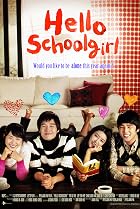
Kwon Yeon-woo (Yoo Ji-tae) is a 30-year-old civil servant who just moved into a new apartment building. Han Soo-young (Lee Yeon-hee) is an 18-year-old schoolgirl who lives with her single mom (Na Young-hee), just one storey below. It is inevitable that they’ll meet, sooner or later. Soo-young seems annoyed by him at first, but then realizes that Yeon-woo is just shy. Slowly but surely the two fall in love, but will their significant age difference be a problem? Of course it will, because Soo-young’s mother doesn’t approve of their relationship. Meanwhile, Yeon-woo’s friend and colleague Sook (Kang-in) has been experiencing some heartache of his own. He has fallen in love with Ha-kyeong (Chae Jung-an) a woman significantly older than him, who isn’t completely over her ex just yet. Will love conquer all? Is it better to have loved and lost? And is there really such a thing as a cat-dog? 
Hello, Schoolgirl (original title: Soon-jeong-man-hwa) director Ryoo Jang-ha‘s second film and it’s based on a popular South Korean webcomic called Love Story by Kang Full. It’s unfortunate that the director hasn’t done a new film in five years now, because he really showed some promise and talent with this film. While we’ve seen this type of story repeatedly, this film feels like a fresh take on the romantic comedy. It distinguishes itself for its genuine heart and gleeful naiveté. However it’s the actors that really make this film come alive and the good news is that they’re all fantastic, especially the leads (Yoo Ji-tae and Lee Yeon-hee). Also, worth mentioning is Choi Soo-young, who will of course be known to KPOP fans as a member of Girls’ Generation. I must say that I particularly enjoyed her performance, it would be great to see her in more films.
While the film is incredibly charming and undeniably sweet and romantic, it’s not without its flaws. The two romances almost feel like separate movies, and while the characters are connected it almost sometimes you just want the film to move on to the main storyline. Like I said though, it’s hard to resist the film’s cuteness and that’s the beauty of South Korean romances. They’re almost like fantasies: Too perfect, too cute, too romantic to be true. However I must say, that when things get complicated in the relationships I was completely taken by the film and unsure if things were going to resolve, and I’ve seen my fair share of romantic comedies so of course I should know that everything will be fine, but will it? So the my hats off to everyone for creating such an engaging story with characters you can actually care about and relate to.

Senin, 18 Februari 2008

Love Phobia

Image result for Love Phobia film cover
        
        One sunny day, a young boy named Jo-kang meets a curious young girl dressed in a bright yellow raincoat. She tells everyone in school that she is an alien and whomever she touches will be harmed. Everyone in that school becomes afraid of her, except Jo-kang. Jo-kang befriends the girl, Ari, and falls instantly in love with her. The quirky Ari loves telling Jo-kang stories, and he believes everything she says and is willing to do anything for her. After he and Ari huddle together beneath her yellow raincoat one rainy day, Jo-kang becomes sick with measles. Soon afterwards, she disappears.
       Ten years later, Ari contacts Jo-kang, now in high school, and asks to meet again. Although they have not seen each other in a decade, they have a wonderful time together, and their love begins anew. Ari tells him that she lives at a temple on a mountain that's actually a volcano, and that hot springs surround it. Jo-kang believes her when she tells him that her English got better after she was given lessons by an English ghost who visits her when she's naked. She also tells him that she plans to marry a banker so that she'll be able to rob his bank and leave the planet. Jo-kang travels all night to bring Ari her favorite dish from his home, presenting it to her as a surprise the next morning. She kisses him and Jo-kang catches the flu. Then Ari disappears once more, leaving Jo-kang devastated.
       Jo-kang becomes an adult, and one day Ari appears again in front of him and tells him to come with her. At first he ties her leg to a chair with shoelaces so she can't get away. Later that evening at his home, Ari explains to Jo-kang's father, a sushi chef, that people from NASA kidnapped her since the magnetic force in her body attracts the UFO's. Jo-kang makes plans for the next day, but Ari tells him that she is leaving for the States. Upon leaving, Ari reminds Jo-kang not to cross the line she drew on the ground, something she constantly told him in their childhood.
       One of Jo-kang's friends gets into an accident and when Jo-kang visits his friend at the hospital, he sees Ari there as a patient. Filled with pain and confusion, Jo-kang visits Ari's uncle, a monk, and pours gasoline on himself, threatening to set himself on fire unless he learns the truth. He discovers that Ari is suffering from HIV/AIDS that was accidentally transmitted to her at a hospital where she was taken after an accident that caused the death of her father.
     Jo-kang goes to an exhibit where Ari's photographs are displayed, and afterwards he piggybacks her to a grassy lawn where she explains that crop circles are signs left by a UFO. Later that night, Ari falls sick and is admitted back to the hospital. Jo-kang stands outside the hospital, getting wet in the rain. But when Ari's uncle tells him to come inside, Jo-kang replies that he's obeying Ari's instruction not to cross her line on the ground.
      Jo draws designs on the grassy lawn, and takes Ari there against doctor's orders, telling her to fulfill her destiny to leave the planet. Ari passes the last moments of her life telling Jo-kang that she loves and pities him for believing everything she said. Jo-kang then sees a flying saucer appear in the night sky, signifying Ari's death.
     In the final scene, Jo-kang goes on with his life, narrating in voice-over that the scent of love that Ari left still lingers. He prefers to believe that she's living on another planet, waiting for the day that they will meet each other again.

Kamis, 30 November 2006

Once in a Summer


Image result for once in a summer korean movie

      At first glance, Once in a Summer looks like your typical nostalgic tearjerker aimed at mass audiences. Long before it was released, the distribution rights were sold for US$4 million to Japan, where films of the pure love genre have performed very well. The film was also co-written by Kim Eun-Hee and Kim Eun-Sook, who've collaborated on several successful Korean dramas. And the biggest factor of all: it stars Korean heartthrob Lee Byung-Hun as a romantic lead. The film looks like just another another formulaic attempt to cash in on collective nostalgia - a type of film that Korean Cinema already has far too many of. However, despite looking like an obvious product for the masses, Once in a Summer is actually not all that bad.

     Once in a Summer opens in modern day at a television station where a writer tries to save her job by claiming to have booked famed professor Park Suk-Young (played by Lee in gray hair makeup), who was once her professor. After seeking him out, he agrees to go on the show if she can find a woman named Seo Jung-In (played by Soo Ae). It turns out Suk-Young (played without gray hair by Lee) was a politically apathetic student in 1969 South Korea. To get out of working for his father's company, he followed his left-wing radical classmates to a rural town to work for the summer as a volunteer. There, he met Jung-In, the local librarian who was treated especially harshly by the mayor because of a past crime her family committed, making her the black sheep of the village. Suk-Young falls in love at first sight, but Jung-In requires a little romancing before she can return the affection. But even once they've finally fallen in love, her family's past and the politically-turbulent time come to tear the happy couple apart.

     Once in a Summer may just be another way for Korean filmmakers to cash in on nostalgia, but credit director Jo Geun-Sik and his screenwriters for using it as more than just a way to create tragedy. Little bits of period detail, such as the small town's attempt to install electricity, an outdoor public movie screening, and the villagers gathering to watch the Armstrong moon landing, effectively place the viewer into the mood of the times. While the past does end up being used to create tragedy, Jo manages to establish a nice balance for most of the way - at least enough that people won't criticize him for whitewashing history. Despite that, the use of the Park Chung-Hee regime to create a fictional "pure love" story seems contrived by any means, and Once in a Summer is sadly no exception.

     Luckily, Lee works extra hard to show why he's one of Korea's best actors. The role of Suk-Young is not a stretch for Lee, who gave a chilling performance in 2005's A Bittersweet Life. However, he manages to exude enough boyish charm to make him an easy character to root for, despite being a few years too old for the role. Soo Ae does fine with her character, who is so innocent that she can't even bring herself to read a sex scene from a novel for the village elders. Soo does transition between lovable and tragic modes fairly well, but Lee's is really the performance that keeps the movie going.

     The problem with Once in a Summer isn't its somewhat uncomfortable mix of innocent love and political turmoil, but really how formulaic the whole exercise is. Fix two attractive stars together, put in touching melodrama, a bit of violence, some tragedy, and a movie is concocted. There's lots of tears, people getting slapped around, and even an embrace in the rain. On the other hand, Jo does try to tone down the romance portion, which can be a good thing. But sometimes a formula is there for a reason, and the romance in Once in a Summer feels too platonic for it to make the type of impact that the film seems to think it did. The film is entertaining, the stars are attractive, and they have suitable chemistry to make the romance work, but when the audience doesn't feel the romance, they can't get involved when tragedy strikes. It's rare that I wish for a Korean melodrama to be less subtle, but this is one of those times.

Kamis, 16 Februari 2006

A Millionaire's First Love

Hasil gambar untuk A Millionaire's First Love

Kang Jae-kyung (Hyun Bin) is your typical rich kid. He is arrogant, drives sporty cars, attends the big clubs and rides through school corridors on his motorcycle. As his 18th birthday approaches, he is set to inherit his grandfather's fortune, but first Jae-kyung is required to transfer to a new school in Gangwon Province and graduate. Until then all access to his penthouse, cottage and credit cards are denied. Should he fail to graduate or drops out then he loses everything. If he wishes to give up, he will only receive 0.1% of his over-all inheritance. With this in mind, he heads out to the countryside, to a small town in which daily life is far removed from what he is used to.
Shortly after settling into his new home, he meets 19-year-old Choi Eun-hwan (Lee Yeon-hee), who happened to run into him back in Seoul. They don’t exactly hit it off; he’s far too stubborn and cool for school. Conversely, she sees hope for him and sets out to make him see it for himself. They eventually draw closer, thanks to a set of coincidences and school projects. Jae-kyung learns of Eun-hwan's terminal disease and does what he can to make her happy. He even tells his lawyer that he would give up his inheritance so he could buy an orphanage for her.
One day during the rehearsal of a play at school, Jae-kyung notices that the play is resembles the incident that had happened in his life. He recalls a childhood memory of being at the orphanage at Gangwon, where he had met Eun-hwan and had made a promise to return in ten days. He finds Eun-hwan and tells her that he did not remember her or his promise because his parents had died in a car accident on that same day and his memories were thus erased. He tells her he loves her and they kiss.
The day of the play comes and Jae-kyung asks his classmate to trade places as a favor; him as the Colonel rather than the maid. He goes to Eun-hwan's side and she asks him if he could put on the socks he bought her earlier. While they are dancing, she feels a sudden pain and goes backstage much to Jae-kyung's worry. However, she returns. Eun-hwan's mother has also come to see the show.
Later, they celebrate the success of the play. The couple sit on a swing, Eun-hwan tells Jae-kyung "I love you" and that she's sleepy. Before falling asleep, she tells Jae-kyung to wake her up after 3 minutes. Soon after, the first snow comes.
On their graduation day, Eun-hwan receives the Award of Friendship but does not attend the ceremony as she never woke up. A bouquet of white flowers sits in her seat instead, next to Jae-kyung's chair. He stays for a while and walks outside carrying the flowers. His grandfather's lawyer comes, congratulates him and tells him that the inheritance is now his.
Later, Jae-kyung builds a house with numerous windows in memory of Eun-hwan. He states that after 50 first snows hit its windows, they will meet again

Minggu, 25 Desember 2005

My Girl and I

Image result for My Girl and I


My Girl and I (Hangul: 파랑 주의보; lit. A Heavy Seas Warning) is a 2005 South Korean film directed by Jeon Yun-su. It is a remake of the Japanese film Crying Out Love, In the Center of the World, adapted from the novel Socrates in Love by Kyoichi Katayama.

The film starts in modern-day Korea where we see Kim Su-ho (Cha Tae-hyun) return to his hometown after ten years to attend a reunion with his high school friends. He sadly strolls as he hears a female voice in his head calling out his name.
The next scene shows us Su-ho's three friends celebrating and talking about Su-ho. They doubt that he'll attend their reunion because he apparently hasn't gotten over some girl. It is said that on that day of their reunion, it is the death anniversary of a girl named Bae Su-eun (Song Hye-kyo). To everyone's surprise, Su-ho enters and warmly greets his friends.
After celebrating, the four friends go to a lighthouse where Su-ho's friend shouts, "Bae Su-eun, my friend's brain is small but is filled with endless thoughts of you. Please let my friend go." Su-ho starts to cry.
The next scene is a flashback wherein a younger Su-ho is rescued from drowning by a pretty girl. Her pager gets lost in the process of rescuing him but she just walks away. Su-ho then wakes up and thinks that his friends saved him from drowning.
The next scene leads us to a music class. Su-ho and his classmates sing in chorus. He sang normally just like the other students but was distracted when his classmate, Bae Su-eun started staring at him. Su-ho is confused. Su-ho's friend says Su-eun always stares at him in class. Su-ho starts to think that Su-eun may actually be interested in him but was not.
Su-ho and Su-eun pass by in the hallway. Su-ho tries to walk away when Su-eun called him. She asks him to buy her a croquette which surprises Su-ho. He says that if he and Su-eun ate together, other people might think that they are dating and cause trouble. Still they eat together, and the other students notice.
Soon the captain of the judo club who had his eyes set on Su-eun finds Su-ho. He threatens to hurt Su-ho who immediately denies dating her. Su-eun passes by and when the captain asks, she quickly replies that they are indeed dating. The captain throws Su-ho down. Su-ho's friends arrived to rescue him and they escape by bike.
Su-ho and Su-eun stay by the boardwalk near a lighthouse. Su-eun hints to Su-ho that she saved him but he fails to understand. She asks him to replace her pager. They watch the sunset together.
Su-ho then walks Su-eun home and she writes her beeper number on a pomegranate for she was afraid her strict father would find out. Although her beeper was lost, she could still receive and leave messages. That night, they confess their feelings for each other.
The next day, Su-ho is called out of class because his grandfather supposedly collapses. He quickly goes to his grandfather's but finds him well. It turns our he faked illness so that he could talk to Su-ho. Su-eun arrives bringing Su-ho's bag. Su-ho's grandfather shares his story.
When he was young, Su-ho's grandfather joined the army. He was separated from his first love, Soon-im. He left her a necklace to remember him by.
Years pass and he becomes an undertaker. He prepares a funeral for Soon-im's husband. They could not even say a word to each other and soon he married another woman, Su-ho's grandmother.
Su-ho then realizes that he loves Su-eun and he wishes for her to be his destiny so that they would not suffer the same fate as his grandfather. Using a payphone, Su-ho left a message on Su-eun's pager. In it he said that he wished she could be his destiny, completely unaware that she was behind him until she replied, "Me too."
From that day on, Su-ho and Su-eun officially became a couple.
Su-ho's friends propose an overnight stay in Fog Island. As Su-ho and Su-eun arrived together at the pier, he finds out that his friends tricked him so that he and Su-eun would have some time alone. Su-eun seemed mad but then she herself bought two tickets to Fog Island.
On the island their love deepens even more. They share their first kiss.
The next day, Su-eun faints. Su-ho rushes her to the hospital, visiting her every day. What he thought was just simple anemia turns out to be terminal leukemia. Her last wish is to return to their island.
Another woman also had a last wish before she died—Soon-im. She wished to be reunited with her first love, Su-ho's grandfather. He even prepared her funeral and was reunited with his first love, the woman he had loved for 50 years.
One day, when Su-ho visited the hospital, Su-eun expresses her wish and he shows her two ferry tickets. On the day of their departure, a typhoon prevents the ferries from running. Su-ho desperately tries to convince the authorities to let them travel.
As he argues with the management, Su-eun knows it is her time. As he apologizes to her, she collapses onto him.
In the present, Su-ho returns to Fog Island and finds Su-eun's bag. Her diary entry reveals that she had planted seeds on the hill during their visit. The flowers will be her gift to him.
Su-ho goes to the hill, finding it covered with purple flowers.

Rabu, 26 Oktober 2005

Sad Movie


  Image of Sad Movie

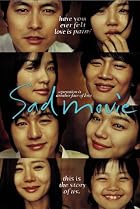
     Imagine a film in which likeable characters encounter life-altering problems, struggle to overcome them, and then seem to actually make some headway, only to have all their hopes eventually dashed in a swift and brutal fashion. If you can do that, you'll have some inkling of what Sad Movie is all about. Director Kwon Jong-Gwon (S Diary) assembled a star-studded cast for this ensemble piece that more than lives up to its melancholic title. Despite being upfront about its content, Sad Movie isn't a melodrama in the conventional sense. In fact, the majority of the film plays out as a cute, consistently funny romantic comedy, a fact that only amplifies the sense of betrayal and/or shock many viewers will feel by story's end.
     Rather than focus on one driving plotline, the film is a collection of four stories that all intersect at some point, although they remain basically unrelated. First off, there's Jin-Woo (Jung Woo-Sung of A Moment to Remember), a handsome, noble, but lunkheaded firefighter dating a sign language interpreter named Su-Jung (Im Su-Jung of A Tale of Two Sisters). It looks like the two are ready to take the next big step in their relationship, but Jin-Woo's unwillingness to give up his dangerous profession and his occasional obliviousness to Su-Jung's needs keeps derailing any plans for wedding bells between the two.
     Su-Jung lives with her sister, the cheerful Su-Eun (Shin Min-Ah of A Bittersweet Life). Although she provides the occasional moral support for her sister and "brother-in-law," Su-Eun has problems of her own. While working at a theme park as a Raggedy Ann-like Snow White, she falls in love with a portrait painter named Sang-Gyu (Lee Ki-Woo). The only problem is that Su-Eun is a deaf mute with a scar on the side of her cheek, facts which prevents her from approaching Sang-Gyu without wearing her oversized mask and costume. With the help of her ridiculously cute co-workers, the Seven Dwarves, Su-Eun hopes to overcome her shyness and connect with the handsome artist.
     Then there's Ju-Yung (Yeom Jung-Ah), a working mother whose commitment to her job causes a rift between her and her lonely son Hui-Chan (Yeo Jin-Goo). Things begin to change when Ju-Yung is caught in a car accident and sent to the hospital. While his mother is laid up in a hospital bed, Hui-Chan stumbles upon his mother's diaries and begins to learn the truth about his conception, birth, and early childhood. Soon, he begins to bond with his mother, just as she discovers that she's suffering from cancer. 
     Along the way, Hui-Chan crosses paths with Ha-Seok (Cha Tae-Hyun of My Sassy Girl), an unemployed shlub who makes extra money as a human punching bag for a local boxer. Meanwhile, his girlfriend Suk-Hyun (Son Tae-Yung) is sick of her dead-end job as a cashier and when Ha-Seok's credit card is declined at her place of employment, she realizes she's tired of waiting for her boyfriend to grow up and promptly dumps him. Ha-Seok begs her to give him a three month grace period and heads off seeking steady employment. After a chance encounter with a woman breaking up with her boyfriend, Ha-Seok hatches a scheme to start a "Separation Agency" that will break up relationships when one party is too scared to do it face-to-face. His wild idea quickly turns into a lucrative business, giving Ha-Seok hope that he'll finally win his girlfriend back.
     At face value, Sad Movie is a collection of tried-and-true formulas. There's the couple with commitment issues, the shy girl caught up in a "Meet Cute" scenario with the boy of her dreams, the mother-son terminal illness tearjerker, and the gimmicky, high concept romantic comedy all on display in Sad Movie. While it's arguable that each story could stand on its own, it's perhaps wise that the filmmakers decided to intercut among the four. Not only does the decision make for a more involving film, but it also ensures that each storyline doesn't wear out its welcome.
     Despite what the title suggests, Sad Movie is a consistently funny film. It has all the makings of a light, fluffy romantic comedy, but to its credit, it's a thoroughly enjoyable one. That's not to say that the film isn't full of emotion (as is the case with the mother-son cancer storyline), but much of Sad Movie is anything but sad or depressing. Ha-Seok's unflappable dedication to his new job, Hui-Chan's kiddy antics, Su-Eun's internal snarky commentary, and Jin-Woo's clueless behavior all provide ample chuckles throughout the picture. What stands out most about the film is how intensely likeable the all-star cast is, a quality that allows the viewer to immediately get involved in the story and hope things will work out for the best.
     And that's the trick being played on the audience in Sad Movie. After more than an hour of warming the heart and tickling the funny bone of its audience, Sad Movietakes a melodramatic turn for the worse. As the saying goes around LoveHKFilm.com, IT ALL GOES TO HELL! Everything that can go wrong does go wrong for our heroes in brutally swift succession. Considering all the goodwill the film has accrued up until that point, when all the gloom and doom is handed out, it feels like a kick to the chest. Although there were some tears shed by the audience, this reviewer was dry-eyed, mainly out of shock, as the film proceeded to end on perhaps the lowest note possible.
     To be fair to the filmmakers, in addition to the title, the storylines themselves do actually give audiences a clue as to what will transpire. A man unwilling to give up his dangerous job, a mother afflicted with cancer, a girl too shy to show her face to the boy she has a crush on, and a guy trying to win back his girlfriend who dumped him all seem like recipes for disaster in varying degrees. But still, with the filmmakers unceremoniously pulling the rug out from under the viewer after all that positive build-up, the ending ultimately begs the question, "Why?" Just to be different? 
     In some ways, Sad Movie can be read as a send-up of the various clichés that typify melodramas and romantic comedies. By dashing the audience's expectations, perhaps the filmmakers want to emphasize that in real life, there are no guarantees for a happy ending. While such genre-tweaking innovation can be admired, the execution of the ending seems a bit overblown. Truthfully, three of the endings aren't too devastating, but the final one, the one that serves as Sad Movie's capper, is a little too over the top, as if the filmmakers were purposely trying to elicit tears. That's not to say that Sad Movie should have had a gloriously happy ending. Such a climax would have felt fake to be sure, but something more bittersweet, and ending with a little more light in the darkness might have felt slightly more satisfying.
     But having said all that, the fact remains that Sad Movie is an entertaining ride up until the quadruple sad ending. Fans of My Sassy Girl will be delighted to see Cha Tae-Hyun again, as the actor nearly steals the show from his equally famous co-stars. The other actors do well with their characters with Shin Min-Ah and child actor Yeo Jin-Goo being particular standouts. On the basis of the intense likeability of the characters, the mostly humorous content, and the deft juggling of the various storylines, Sad Movie definitely merits at least one viewing. Repeat viewings, however, might be a challenge. So be forewarned: no matter how happy this movie gets, when the filmmakers say the title is Sad Movie, they aren't kidding around.