Rabu, 26 Oktober 2005

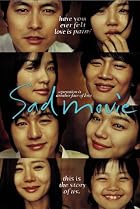
Sad Movie


  Image of Sad Movie

     Imagine a film in which likeable characters encounter life-altering problems, struggle to overcome them, and then seem to actually make some headway, only to have all their hopes eventually dashed in a swift and brutal fashion. If you can do that, you'll have some inkling of what Sad Movie is all about. Director Kwon Jong-Gwon (S Diary) assembled a star-studded cast for this ensemble piece that more than lives up to its melancholic title. Despite being upfront about its content, Sad Movie isn't a melodrama in the conventional sense. In fact, the majority of the film plays out as a cute, consistently funny romantic comedy, a fact that only amplifies the sense of betrayal and/or shock many viewers will feel by story's end.
     Rather than focus on one driving plotline, the film is a collection of four stories that all intersect at some point, although they remain basically unrelated. First off, there's Jin-Woo (Jung Woo-Sung of A Moment to Remember), a handsome, noble, but lunkheaded firefighter dating a sign language interpreter named Su-Jung (Im Su-Jung of A Tale of Two Sisters). It looks like the two are ready to take the next big step in their relationship, but Jin-Woo's unwillingness to give up his dangerous profession and his occasional obliviousness to Su-Jung's needs keeps derailing any plans for wedding bells between the two.
     Su-Jung lives with her sister, the cheerful Su-Eun (Shin Min-Ah of A Bittersweet Life). Although she provides the occasional moral support for her sister and "brother-in-law," Su-Eun has problems of her own. While working at a theme park as a Raggedy Ann-like Snow White, she falls in love with a portrait painter named Sang-Gyu (Lee Ki-Woo). The only problem is that Su-Eun is a deaf mute with a scar on the side of her cheek, facts which prevents her from approaching Sang-Gyu without wearing her oversized mask and costume. With the help of her ridiculously cute co-workers, the Seven Dwarves, Su-Eun hopes to overcome her shyness and connect with the handsome artist.
     Then there's Ju-Yung (Yeom Jung-Ah), a working mother whose commitment to her job causes a rift between her and her lonely son Hui-Chan (Yeo Jin-Goo). Things begin to change when Ju-Yung is caught in a car accident and sent to the hospital. While his mother is laid up in a hospital bed, Hui-Chan stumbles upon his mother's diaries and begins to learn the truth about his conception, birth, and early childhood. Soon, he begins to bond with his mother, just as she discovers that she's suffering from cancer. 
     Along the way, Hui-Chan crosses paths with Ha-Seok (Cha Tae-Hyun of My Sassy Girl), an unemployed shlub who makes extra money as a human punching bag for a local boxer. Meanwhile, his girlfriend Suk-Hyun (Son Tae-Yung) is sick of her dead-end job as a cashier and when Ha-Seok's credit card is declined at her place of employment, she realizes she's tired of waiting for her boyfriend to grow up and promptly dumps him. Ha-Seok begs her to give him a three month grace period and heads off seeking steady employment. After a chance encounter with a woman breaking up with her boyfriend, Ha-Seok hatches a scheme to start a "Separation Agency" that will break up relationships when one party is too scared to do it face-to-face. His wild idea quickly turns into a lucrative business, giving Ha-Seok hope that he'll finally win his girlfriend back.
     At face value, Sad Movie is a collection of tried-and-true formulas. There's the couple with commitment issues, the shy girl caught up in a "Meet Cute" scenario with the boy of her dreams, the mother-son terminal illness tearjerker, and the gimmicky, high concept romantic comedy all on display in Sad Movie. While it's arguable that each story could stand on its own, it's perhaps wise that the filmmakers decided to intercut among the four. Not only does the decision make for a more involving film, but it also ensures that each storyline doesn't wear out its welcome.
     Despite what the title suggests, Sad Movie is a consistently funny film. It has all the makings of a light, fluffy romantic comedy, but to its credit, it's a thoroughly enjoyable one. That's not to say that the film isn't full of emotion (as is the case with the mother-son cancer storyline), but much of Sad Movie is anything but sad or depressing. Ha-Seok's unflappable dedication to his new job, Hui-Chan's kiddy antics, Su-Eun's internal snarky commentary, and Jin-Woo's clueless behavior all provide ample chuckles throughout the picture. What stands out most about the film is how intensely likeable the all-star cast is, a quality that allows the viewer to immediately get involved in the story and hope things will work out for the best.
     And that's the trick being played on the audience in Sad Movie. After more than an hour of warming the heart and tickling the funny bone of its audience, Sad Movietakes a melodramatic turn for the worse. As the saying goes around LoveHKFilm.com, IT ALL GOES TO HELL! Everything that can go wrong does go wrong for our heroes in brutally swift succession. Considering all the goodwill the film has accrued up until that point, when all the gloom and doom is handed out, it feels like a kick to the chest. Although there were some tears shed by the audience, this reviewer was dry-eyed, mainly out of shock, as the film proceeded to end on perhaps the lowest note possible.
     To be fair to the filmmakers, in addition to the title, the storylines themselves do actually give audiences a clue as to what will transpire. A man unwilling to give up his dangerous job, a mother afflicted with cancer, a girl too shy to show her face to the boy she has a crush on, and a guy trying to win back his girlfriend who dumped him all seem like recipes for disaster in varying degrees. But still, with the filmmakers unceremoniously pulling the rug out from under the viewer after all that positive build-up, the ending ultimately begs the question, "Why?" Just to be different? 
     In some ways, Sad Movie can be read as a send-up of the various clichés that typify melodramas and romantic comedies. By dashing the audience's expectations, perhaps the filmmakers want to emphasize that in real life, there are no guarantees for a happy ending. While such genre-tweaking innovation can be admired, the execution of the ending seems a bit overblown. Truthfully, three of the endings aren't too devastating, but the final one, the one that serves as Sad Movie's capper, is a little too over the top, as if the filmmakers were purposely trying to elicit tears. That's not to say that Sad Movie should have had a gloriously happy ending. Such a climax would have felt fake to be sure, but something more bittersweet, and ending with a little more light in the darkness might have felt slightly more satisfying.
     But having said all that, the fact remains that Sad Movie is an entertaining ride up until the quadruple sad ending. Fans of My Sassy Girl will be delighted to see Cha Tae-Hyun again, as the actor nearly steals the show from his equally famous co-stars. The other actors do well with their characters with Shin Min-Ah and child actor Yeo Jin-Goo being particular standouts. On the basis of the intense likeability of the characters, the mostly humorous content, and the deft juggling of the various storylines, Sad Movie definitely merits at least one viewing. Repeat viewings, however, might be a challenge. So be forewarned: no matter how happy this movie gets, when the filmmakers say the title is Sad Movie, they aren't kidding around.

Kamis, 23 Juni 2005

My Sassy Girl

Image result for My Sassy Girl


The oddest thing about Jae-young Kwak’s “My Sassy Girl” is that its entire premise of a young, 20-something woman acting outrageous and going against the norm of how a “young woman” is supposed to behave is not, well, all that outrageous. Perhaps in Korean society, which takes its cue from the closed and internalize structure of Japanese culture, the Girl character played by Ji-hyun Jun might be “out there.” To everyone else she just comes across as a free-spirit and not the 10,000 pound elephant squatting in the middle of the living room that characters in the movie make her out to be.
“My Sassy Girl” begins innocently enough with Kyun-woo, a 20-something college student waiting for the subway after some drinks with the boys. That’s when he encounters a 20-something girl (or young woman, actually) who is obviously very drunk. Kyun-woo, seeing that the girl is unbalanced and standing too close to the edge of the tracks, quickly pulls her away, probably saving her life. Later in the subway car, the girl causes a scene, but not before turning to Kyun-woo and calling him “Honey,” thereby implicating him in her problems (or at least in the other passengers’ eyes). After injecting himself into the Girl’s life, Kyun-woo starts to fall for her, but that’s easier done than, well, surviving it.
Ji-hyun Jun is the titular Sassy Girl, who goes nameless throughout the movie. Even when we meet her family and parents, we still have no idea what her name is. The movie is supposed to be modeled after a real story about a “sassy girl” that appeared in serialized form on the Internet. Regardless, Ji-hyun Jun (“The Uninvited”) is the only real reason to watch this movie. “My Sassy Girl” is a comedy, and there are some very funny moments in it, but it’s Ji-hyun who gives the film its heart and soul. As the tough girl with a heart of gold, she is nearly flawless. Even when she kicks and punches at the men in her life, she still comes across as utterly charming and incapable of doing any wrong. You will be smitten by the young lady’s performance.
Tae-hyun Cha (Kyun-woo) on the other hand mistakes making a permanently constipated face for acting. Both actors look to be in their late teens to early ’20s, but they’re playing mid-20-somethings, and it doesn’t quite work. They’re much too young for their roles (a rather odd “problem” with actor and their roles, to be sure). “My Sassy Girl” works best when it inserts oddball scenes like Kyun-woo’s dramatic but surreal interpretations of the Girl’s many scripts. You see, the Girl has delusions of being a writer, and forces Kyun-woo to read all of her scripts, threatening him with physical violence if he doesn’t like them. As Kyun-woo reads the scripts, the scenes play out like flights of fantasy in his head.
Unfortunately all the credentials the movie builds up, and even the charm of Jun, can’t save the film once it falls into the kiss-of-death that is Asian Melodrama. The movie goes downhill very fast, the laughs cease completely and the movie struggles mightily toward that final, oh-so predictable ending. Jun’s Girl was so good, so tough and yet so vulnerable, that the movie could have kept its laughs and still driven its point home. Instead, it completely abandoned what it had built up for the last hour and a half to give us a sappy ending.
“My Sassy Girl” is a good movie and I suppose it might have been hard to sustain its superior beginning and middle. By movie’s end, the title should have been changed to “My Sappy Film”. But as the saying goes, it was good while it lasted.
Jae-young Kwak (director) / Ho-sik Kim (screenplay)
CAST: Tae-hyun Cha …. Kyun-woo
Ji-hyun Jun …. The Girl

Kamis, 10 Juni 2004

Windstruck

Hasil gambar untuk Windstruck
The film stars Jun Ji-hyun as Officer Yeo Kyung-jin, an ambitious young female police officer serving on the Seoul police department. One day while chasing a purse snatcher, she accidentally captures Go Myung-woo (played by Jang Hyuk), a physics teacher at an all-girls school, who was actually trying to catch the thief. Later, Myung-woo discovers the stolen purse, but just as he picks it up, Kyung-jin spots him and tries to arrest him again. Kyung-jin is then given the job of escorting Myung-woo through a dangerous district, only to be distracted when she tries to break up a meeting between Russian Mafia and Korean gangsters. With Myung-woo handcuffed to her, Kyung-jin almost single-handedly brings down the two rival gangs (although she is helped when she accidentally causes the groups to start shooting at each other).
The first half of the film, told from Myung-woo's point of view, details the couple's growing attraction and love for each other, which climaxes with a trip to the countryside where Myung-woo tells Kyung-jin that if he were ever to die, he wanted to come back to earth as the wind. Soon after, he is almost killed in a freak automobile accident, but Kyung-jin saves his life.
The film takes a turn into the fantasy genre in its second half after Myung-woo is accidentally shot and killed by another officer (although the situation is such that Kyung-jin thinks that it was her shot that killed him) as Kyung-jin chases after a criminal. Kyung-jin falls into a suicidal depression over his death and attempts to kill herself several times, almost succeeding when she throws herself off a building, only to be saved when a giant balloon floats under her. Soon after, she experiences visitations from Myung-woo, who appears as the wind, sending her messages and, at one point, he even appears in her dreams in order to give her the will to live after she is nearly shot to death by a criminal.
Ultimately the film follows a similar path set out by the American film Ghost with Myung-woo and Kyung-jin communicating and sharing one final gesture of love before he moves on to the afterlife. Myung-woo said that he will whisper, when she hears him whisper in the wind, she will meet someone with a soul like him. Myung-woo told Kyung-jin that he will always be beside her inside a book with a photo left by Myung-woo in the restaurant before he rushed to meet Kyung-jin who was chasing the insane criminal.
In the first half of the film, Myung-woo told that his only memory of high school was his high school trip. The book and the photo is found and returned to Kyung-jin in the police station. The photo showed that on Myung-woo's trip, Kyung-jin was nearby. This proved Myung-woo's "I'm always beside you" was true to Kyung-jin. Kyung-jin rushed out to locate the finder of the book, ultimately ending up in the train station, where she is saved by Cha Tae-hyun's character (credited as The Guy). Myung-woo whispered that The Guy is the one with the soul like him. Kyung-jin whispers that "he is always beside her."

Sabtu, 10 April 2004

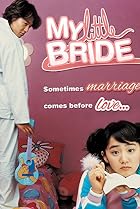
My Little Bride

Image of My Little Bride

My Little Bride is such a sweet, little film that gets the credit for my present addiction towards Kdramas. It was a huge hit and is one of the most watched movies by the Non-Korean audience. I love it and it fills me with exuberance every time I watch it!!
Kim Rae Won is a wannabe playboy, fresh out from college and Moon Geun Young is still in high school. Both of them are best friends since childhood. They are forced to get married due to family pressure and then starts their journey towards dealing with this new relation between them and realizing the love they always had but were oblivious towards it. Also, our heroine hides this thing from her school mates, which make the things more interesting for us. And yeah, she even has a crush on one of the boys there.
The movie is cute beyond words and the age gap between the leads never looks weird and of course it’s not very large. Together, Kim Rae Won and Moon Geun Young set off such sparks, that the strength of their chemistry alone is enough to make you love this film. The movie is full of many romantic and cute moments. All the characters make you feel warm. I cannot say much about the music, but I liked the song that is played in the end credits. Marriage of convenience is one of my darling topics and this film shows it beautifully. The day to day life of the persons, who never treated each other romantically but now live under the same roof, is filmed with much detailing and good pace. The movie binds you with its simple charm, its immensely likeable characters, and the intrinsic humor in the writing. The direction is really good.
My Little Bride has a lot of heart and the emotional part is attached with the script naturally and effectively. You feel with the characters.
Kim Rae Won is amazing in this role, perfectly balancing the immature, childlike behavior and the mature husband part. He is the kind of actor, the more you see him, the more you like him. He has a lot of warmth attached to his acting. Moon Geun Young is brilliant in this role, showing the cuteness and dilemma of getting married so early. They both share an adorable camaraderie. Rest of the supporting cast perfectly compliments the leads.
It’s a movie that wins you with its sweet, heartwarmng moments that will surely bring a smile to your face. I felt disappointed when the film ended as I wanted it to go on forever….

Jumat, 16 Januari 2004

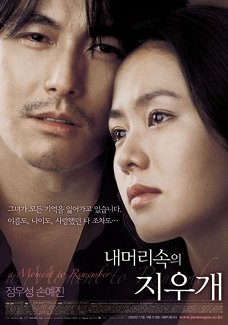
A Moment to Remember

Image result for A Moment to Remember


*Attention! Spoilers*
Kim Su-jin (Son Ye-jin), a gorgeous, young woman is stood up by her lover (Baek Jong-hak), who was supposed to pick her up at the station. Heartbroken and tired, she walks into a random convenience store, buys a coke and decides to walk home. A couple seconds after she leaves the store, she realizes that she forgot her coke inside the store. At the door she meets a handsome, rugged young man (Jung Woo-sung) holding a coke in his hand. She just assumes it’s hers. He opens the can. She takes the soda from him, chugs it down her throat and burps in his face: It’s the beginning of a beautiful love story.

A Moment to Remember (original title: 내 머리 속의 지우개, romanized: Nae Meorisogui Jiugae, which literally means: “Eraser in my head”) is a sappy South Korean melodrama, about a 27-year-old woman diagnosed with Alzheimer’s. It’s an incredibly sad and tender story, that made me tear up quite a bit, to the point where I even had to pause it, because I couldn’t read the subtitles anymore. I rarely go for this type of films, but for some strange reason I was in the mood to watch this yesterday, knowing full and well that I would probably cry like a baby. The whole film is designed to make you weep, and guess what: It works.
The first act of the film is all about setting up the perfect romantic scenery: Girl meets boy, they fall in love, everything is perfect. In the second act you start to see how Su-jin’s condition starts to progressively get worse. The first stages of Alzheimer’s are played for laughs and make the character of Su-jin seem even cuter and more adorable than she already is, but then, as the disease gets worse it’s just one sad scene after the other. Why is it so sad though? Does the film work as a melodrama? What make this such an emotional roller coaster? What does the film have to say about memory loss? And why all the glaring product placement?
Son Ye-jin gives a solid performance as Kim Su-jin, the female lead of the film. It’s unlike any other performance I’ve seen in a Korean film, which kind of makes sense, because I haven’t seen any other Korean films about Alzheimer’s. From the start she is incredibly sweet, delicate and innocent, possibly a bit naive and definitely always with her head in the clouds. She’s rarely focussed, but she’s always spontaneous and kind and as a male viewer I have to say that I easily fell for her. Whether a girl like this exists or not is another question, but in the reality of the film she made perfect sense.
On the other hand you have Jung Woo-sung, playing the male protagonist: Choi Chul-soo. You could say he’s the polar opposite of Sun-jin. He’s kind of a brutish and violent man with a temper. He doesn’t care about his physical appearance that much, which makes their romance a sort of Beauty and the Beast story. Of course though, he has a good heart and all his rage and hate comes from a difficult childhood. He’s not as successful or rich as Su-jin, but he’s a smart, intelligent man. Chul-soo is ambitious and dreams of becoming an architect, so he’s also a bit of an artist. In short: The perfect man.
a-moment-to-remember-2
By establishing these archetypal (not to say cliché) characters, the film immediately sets up what you can expect from it. And if its premise wasn’t heartbreaking or devastating enough for you: The over-dramatic and melancholic soundtrack and score should do the trick. I wasn’t a fan of the Spanish-language music used, but I was happy to hear an Italian song. What I found interesting about A Moment to Remember is that while many scenes feel cliché a lot of the couple’s relationship “milestones” they could have played-up were actually only shown in passing (first kiss, marriage, first time etc.).
There might not be a whole lot going on visually in this film, aside from some annoying cinematography, where they basically painted a purple sky, but there’s one shot I truly loved. As a fan of extreme close-ups, there was one scene where the couple is lying on the floor in Chul-soo’s apartment. The whole screen is just filled with the actors’ faces and you can hear them breathing. I think it’s perfect, because it doesn’t only show how close the two are to each other, but it also brings us, the audience, closer to them and to what they’re feeling and experiencing.
As the film progresses and dwells deeper into the disease, I appreciated how it dealt with memory loss. Granted, it doesn’t show you anything ugly or truly problematic, aside from the young woman progressively forgetting everything. However some great drama comes from that, when she confuses her husband with her ex-lover. A truly devastating scene is when she calls him with her ex’s name and tells him that she loves him. The memory loss aspect is also used to make a comment on how we build everything on our memory (our persona and personality, our relationships etc.). What are we without our memory?
To quote the film: “When a memory is gone, so is the soul, they say”. There are more great lines like this one, that border on cheesiness, but are interesting, because they’re based on Korean folklore and wisdom. So maybe to a Korean viewer they’re horrid clichés, but to a rather inexpert European viewer, such as myself, they still hold some insights (if nothing else cultural ones). Another very Korean thing about this film was the product placement. You normally wouldn’t expect it in a drama, but from what I know Korean people are extremely brand aware and so it makes sense here. I just found it a bit “exotic”.
Towards the end the film gets a little too cocky and even attempts a happy ending, like a riding off into the sunset type of thing. For real. I couldn’t believe my eyes. That was a bit to much. I liked how they showed that Sun-jin remembers that one special moment when she meets Chul-soo. It was sweet, romantic and touching and everything they wanted it to be. It was perfect. I know you don’t want to leave your viewers with a sad image, but unfortunately, they don’t live happily ever after. It only gets worse. I appreciate the film for fully committing and embracing its melodramatic nature, but again, that was a bit too much.
All in all, I was quite surprised by how much I enjoyed A Moment to Remember. I think if you like South Korean dramas, you’ll love this one. Also, and not that they’re my cup of tea, but I was reminded a bit of Nicholas Sparks‘ work, so if you enjoy his books (or the films they’ve made base on them), I’m pretty sure you’ll love this one. Other than that if you’re a bit like me, a little curious and want to see what a South Korean melodrama looks like: This is one of the most recommended and highly rated of its sub-genre. I certainly recommend checking out this film, just make sure you’re in the right mood for it.

Jumat, 28 November 2003

...ing


 Hasil gambar untuk ...ing film

From first-time director Lee Eon-Hee comes …ing, an oddly titled, yet highly engaging romantic melodrama about living life one day at a time. Im Soo-Jung, star of A Tale of Two Sisters, plays Kang Min-Ah, a pretty teenager who has had the misfortune of spending most of her life in hospitals, especially during her formative years. Min-Ah has a deformed hand, and unbeknownst to her, a terminal illness to boot. However, Min-Ah's single mother Mi-Sook (Lee Mi-Sook) does know the truth and keeps it hidden from her daughter, instead trying to turn this negative fact into positive motivation. Although hurting on the inside, Mi-Sook puts on a brave face, encouraging her daughter to take life by the horns and live in the here and now. Min-Ah is skeptical, but soon finds the possibilities of life re-opening to her.
     Soon enough, a photographer named Young-Jae (Kim Rae-Won, from My Little Bride) enters both of their lives by moving into the downstairs apartment. Upon seeing her, Young-Jae immediately does his best to win Min-Ah's attention, engaging in a series of well-intentioned, but slightly juvenile acts that he hopes will make her change her mind about him. Although highly resistant at first, Min-Ah eventually caves in to Young-Jae's goofily charming persistence, and the two embark on a tentative friendship. Much to the delight of her mother, the friendship between Min-Ah and Young-Jae eventually turns to love (albeit chaste), and they soon plan a trip to Hawaii together. But with the bitter realities of Min-Ah's fatal illness looming low on the horizon, one begins to wonder if the budding couple will be able to make it to Hawaii before it's too late.
     With such a small cast, the burden of the film's success lies primarily on the film's three principals, and the actors acquit themselves quite well in their respective roles. As the focus of attention, Im Soo-Jung delivers a memorable performance as Min-Ah. And although they do have some highly charged emotional scenes, Lee Mi-Sook and Kim Rae-Won bring a welcome amount of comic relief to the proceedings, which in itself, is another positive of the film. Rather than bog down the narrative with the kinds of hefty emotional baggage generally associated with the genre, the filmmakers instead use humor as a more natural way to get the audience to identify and/or sympathize with their characters. In fact, part of what makes …ing a solid film experience is that if the terminal illness aspect were eliminated altogether, what remains - a story about a shy, reclusive girl falling in love with an outgoing young man - would sustain a film in and of itself. And considering the plethora of "terminal illness tearjerkers" plaguing the market these days, part of me wishes that element actually was excised from the film. But still, as far as these things go, this is a topnotch melodrama.
     One of the more innovative aspects of the film is that the plot doesn't rely solely on the romance element, but instead gives equal, if not more time, to the unconventional mother-daughter relationship. Because Min-Ah was deprived of friends her own age due to her constant trips to the hospital, her mother asks to be called by her first name, becoming, in effect, Min-Ah's "best friend" from an early age. But even so, the way in which the two characters interact as mother and daughter comes across rather realistically, and Mi Sook's occasional deadpan "revelations" to her daughter always make for entertaining comic digressions.
     Although the specter of Min-Ah's possible death is ever-present in the narrative,…ing feels less heavy-handed and contrived than most melodramas. Even while working within the narrow parameters of the genre, the actors are able to convey a real sense of warmth, humor, and believability, thus making …ing a poignant, yet highly enjoyable cinematic experience. If you're a fan of this type of movie, then …ing won't disappoint. 

Senin, 10 Februari 2003

The Classic

Image result for The Classic
The movie begins with Ji-hye cleaning up her apartment and accidentally stumbling on her mother’s love letters from her first love. As she unfolds the old and yellowed pages, the words used were poetic and sounded like an old-fashion story.
She is interrupted by a phone call from her friend Suk-woo. Suk-woo is dating Sang-min, a popular undergraduate from the drama club. Ji-hye corresponded as Suk-woo for three months with Sang-min. Suk-woo asks Ji-hye to join them for a movie and dinner, on Sang-min’s invitation. Ji-hye agrees and gave a sigh of helplessness as she is also in love with Sang-min.
She goes back to read the old love letters. From the letters she discovers that they were from her mother’s first love, Oh Joon-ha. He was corresponding with Ji-hye’s mother Joo-hee as Yoon Tae-soo. Tae-soo is Joon-ha’s friend/schoolmate and also Joo-hee’s fiancée as arranged by both parents.
But actually Joon-ha had met Joo-hee in his uncle’s hometown during one of his summer vacations before that. Joo-hee had begged Joon-ha to take her to the ghost house opposite the river. She is curious to explore the house but her grandfather forbids her to go there. They had a wonderful day together visiting the ghost house. Both took shelter in the rain after Joo-hee sprained her ankle, and ended up spending the entire day together. When they returned safely to the village in the dark evening, Joon-ha was greeted by Joo-hee’s family, and was given a loud slap by her grandfather. Joo-hee is the granddaughter of a reputable family in the village, and her father is a government minister. Joon-ha is blamed for his inappropriate actions and taking Joo-hee to the ghost house. Joo-hee eventually fell ill and was ferried to the city, and Joon-ha thought he would never see her again.
When Tae-soo approached Joon-ha to write to his fiancé, Joon-ha was pleasantly surprised to know that Joo-hee is Tae-soo’s betrothed. And because of Tae-soo, Joon-ha and Joo-hee manage to meet again. Firstly at Joo-hee’s school piano recital, and then they caught up again at a social dance lesson where they double dated.
The young couple’s relationship was put to the test when Tae-soo confesses to Joon-ha that he is falling for Joo-hee. Joo-hee tried to break-up with Joon-ha over Tae-soo. She does not want to have anything to do with either Joon-ha or Tae-soo as she does not want to hurt anyone, and she felt that the difference (I think in terms of background) between Joon-ha and herself was too big.. But their first break-up was not very successful. Joon-ha decided to tell Tae-soo the truth. Surprisingly, Tae-soo already knew of their relationship because he recognise the necklace that Joon-ha wears, a gift from Joo-hee. The necklace was in turn a gift to Joo-hee from Tae-soo’s father. The kind Tae-soo decides to help the young couple by allowing Joon-ha to use his name on his letters to Joo-hee so that they may continue to correspond behind Joo-hee’s family’s back during the long winter holidays.
Unfortunately, the truth was discovered by Joo-hee’s family, and reported to Tae-soo’s father. In a fit of rage, he whips Tae-soo ruthlessly with his belt. To get back at his father, Tae-soo commits suicide, but was saved by Joon-ha. Overcome with guilt of his friend’s suffering, Joon-ha leaves Joo-hee. He leaves the necklace Joo-he gave him on the doorknob of Tae-soo’s hospital room.
A few years passed and Joo-hee bumps into Tae-soo at a student demonstration. She asks about Joon-ha and found out that he was to be shipped off to war. Tae-soo and Joo-hee manages to send Joon-ha off in time at the train station. As she runs after the train, she returns the necklace to Joon-ha and tearfully asks him to return safely.
Joon-ha fights in the war, and during a retreat, he realised that he left the necklace behind the battlefield. He made his way back into the frontline to retrieve the necklace, and as he was making his way for back to the helicopter, he is injured by a landmine and the camera pulls away as it shows a bloody Joon-ha shaking and reaching for the necklace.
The next screen shows Joon-ha gets off a taxi, and walked into a café. He was meeting Joo-hee. She was overcome with tears as she sees Joon-ha. He asked why she is still single, and informs her that he is already married. As the conversation progressed, Joo-hee realises that Joon-ha has gone blind (most probably blinded from the battle injury). Both wept as Joon-ha tried to return Joo-hee the necklace. But Joo-hee insisted that the necklace belongs to Joon-ha.
Eventually, Joo-hee marries Tae-soo and gives birth to Ji-hye three years later. During a visit to her hometown, she found out that Joon-ha had passed away. He asked for his ashes to be scattered in the village’s river. Joo-hee also found out that he actually married after she did, and has a son. He leaves behind his dairy for Joo-hee.
In the meantime, Ji-hye was confronted by Sang-min of his feelings for her. They got together and went back to Ji-hye’s mother’s hometown to backtrack the story that she has just read…..It seems like the fate of Joon-ha and Joo-hee continues in Ji-hye and Sang-min.
Review:
I watched this movie because it was highly recommended by another Korea movie addict friend of mine. He felt that "The Classic" was better than "Il Mare" and "My Sassy Girl", and felt that I should catch it. Fearing for the throne of my dear "Il Mare", I had to watch it. If it was to be, then I will have to change my name to "The Classic" (doesn’t sound as cool as "Il Mare", it’s all in a good name).
"The Classic" was an entertaining movie with a fair share of laughs and tears. But it lacked the “WOW” factor. You know that feeling that your insides been turned out, and you are forever affected by the movie. Although I felt the only thing that saved “My Sassy Girl” was the ending, but the “WOW” during the ending made up for all the times I was asking myself “Why was this the top grossing Korean movie of the year?” I could not identify the “WOW” in "The Classic". I felt that the similarities drawn between the love stories of mother and daughter was to make up for the sadness that was created in the mother’s version, and that the audience would get some form of relief with the daughter’s eventual partner. I also thought that the director would play on the difference in family background as the main reason for the break-up, instead he picked the weaker plot of friendship. Strange, I felt it would have been a more convincing motivation.
Otherwise, this movie was no different from an atypical Korean sob love story of first love, missed opportunities, and friendship. I felt that the director had bought an off-the-shelf recipe for successful Korean movie when making this movie. The ingredients are 
1. Good looking leads 
2. Beautiful country scenery 
3. First love memorable moments – damsel in distress, caught in the rain, sprained ankle 
4. Common reasons for parting – family, good friend, guilt or self-sacrifice because of terminal disease or … some handicap like being blind 
5. Light-hearted hilarious moments – Tae-soo’s farting act, students fighting for the toilet, social dancing gathering 
6. Tear jerking tragic wailing moments – Joon-ha leaving the necklace on the door knob, the send off at the train station, Joo-hee reaction to Joon-ha’s death 
7. Love gift – the necklace 
8. Twist at the end to bring everything together

Speaking of the twist at the end, I have to say it was not very well executed as the director had already provided obvious clues early on in the movie, e.g. with the poem Sang-min for Ji-hye in his gift. This technically took away the element of surprise with the twist, thus rending the ending “twist-less”(By the way, how did Ji-hye know how the necklace looks like?). I think one-word sums up my view of this movie, predictable. But despite the unsurprising storyline, I have to give credit to the great execution of the cast.
The leads Son Ye-jin and Cho Seung-woo had outstanding chemistry as first loves. Son has this damsel in distress look that no one can resist the helpless expression in her eyes. Cho is the romantic literary who steals Son’s heart with his words and his shy smile. I also felt the boyish Cho and the sweet Son were appropriate in their roles. Even when transcending to their older persona in the movie, both were able to add that touch of age and a sense of lost time on both sides. I enjoyed Lee Ki-woo as the kind yet silly Yoon Tae-soo. But I liked him as the high school student better. He looked awkward as an adult. The surprise find for me was Jo In-sung. Can Korean man get any better! (Who’s talking about his acting).
My favourite scenes were actually the scenes of the boys in school. I am not familiar with Korean history/living, but the regimental way of school life was depicted in a light-hearted manner although it must have been difficult enduring such strict code of school rules. The movie also gave me some insights on youths growing up in a changing Korea. But I wished the director had given me more of that versus the love story.
All in all, I will be keeping the name "Il Mare" for obvious reasons. Watch this if you have time to spare for a heart-tugging (and not heart wrenching) love story on a rainy Saturday afternoon